

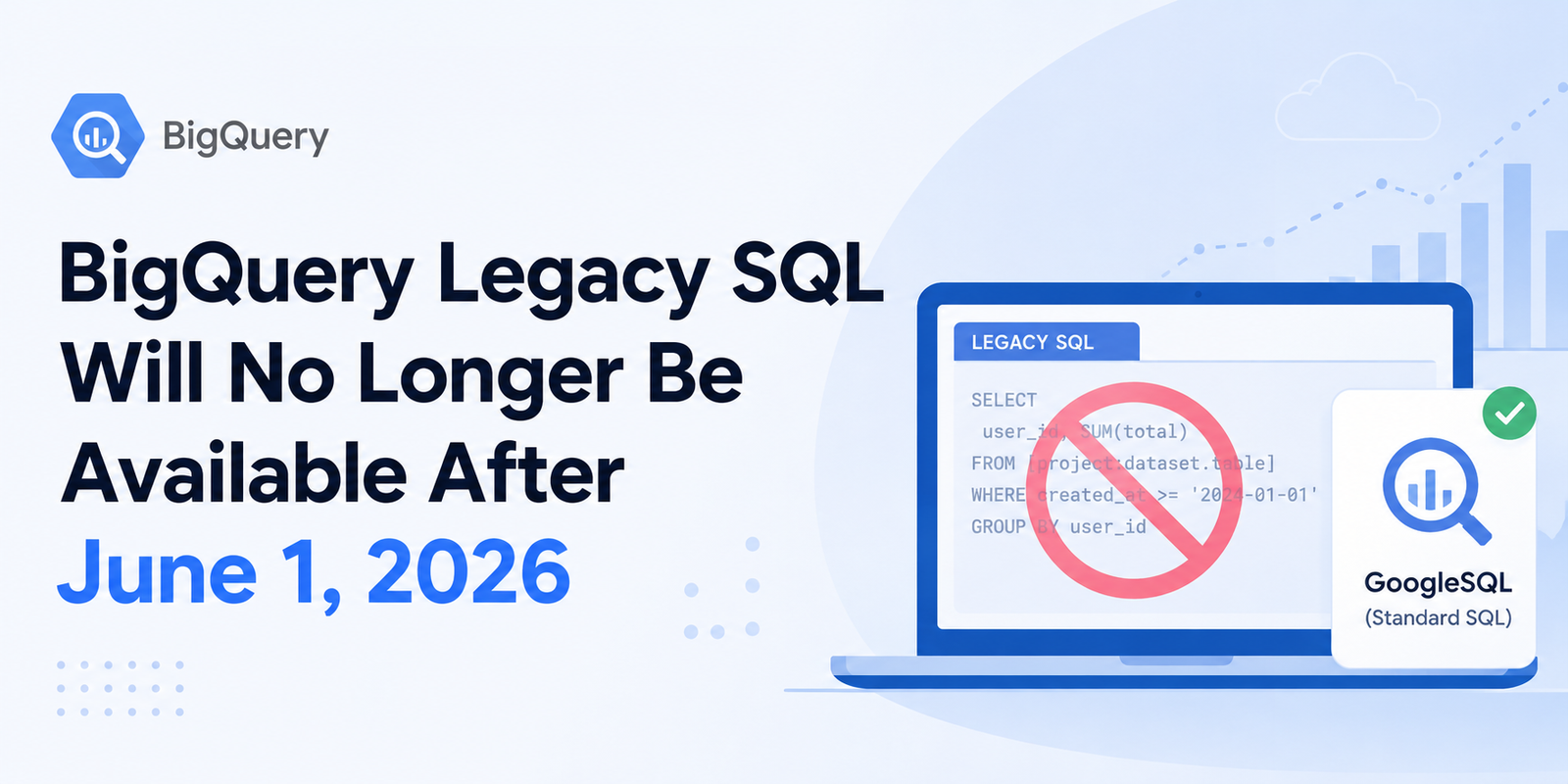
Google has officially announced a major change for BigQuery users that could impact thousands of analytics workflows and cloud-based data systems worldwide. According to Google Cloud documentation, Legacy SQL support in BigQuery will become significantly limited after June 1, 2026, as the company continues its transition toward GoogleSQL, the modern standard query language for BigQuery. (docs.cloud.google.com)
The announcement is especially important for organizations still relying on older BigQuery queries, historical reporting systems, and long-running ETL pipelines built using Legacy SQL syntax.
Although many businesses have already shifted to GoogleSQL over the past few years, a considerable number of enterprises, developers, and analysts still use Legacy SQL for older workflows and archived reporting systems. With this update, Google is making it clear that the future of BigQuery lies entirely with GoogleSQL and modern cloud-native analytics.
What Is BigQuery Legacy SQL?
Legacy SQL is the original query language that was introduced with BigQuery during its early years. Before GoogleSQL became the default standard, Legacy SQL was widely used for querying massive datasets stored inside BigQuery.
BigQuery itself is Google Cloud’s fully managed serverless data warehouse platform designed for large-scale analytics, business intelligence, and data processing. It allows companies to analyze petabytes of data without managing infrastructure. (en.wikipedia.org)
Legacy SQL has a syntax structure that differs significantly from standard ANSI SQL. For example:
SELECT *
FROM [project:dataset.table]
Modern GoogleSQL uses a cleaner and more universally accepted syntax:
SELECT *
FROM `project.dataset.table`
Over time, GoogleSQL became the preferred option because it offers improved compatibility, better readability, and advanced analytical features.
What Will Happen After June 1, 2026?
Google has stated that BigQuery will monitor Legacy SQL usage between November 1, 2025, and June 1, 2026. Organizations that do not use Legacy SQL during this period may permanently lose access to it afterward. (docs.cloud.google.com)
The company clarified that:
- Projects actively using Legacy SQL during the monitoring period may continue running existing workloads.
- However, support and future feature development for Legacy SQL will remain extremely limited.
- New innovations, AI integrations, and performance improvements will focus only on GoogleSQL. (docs.cloud.google.com)
This means organizations depending on Legacy SQL should start planning migrations immediately to avoid future disruptions.
Industry experts believe this is essentially the beginning of the final phase-out process for Legacy SQL within BigQuery.
Why Google Is Moving to GoogleSQL
Google’s decision reflects a broader shift happening across the cloud computing and analytics industry. Modern data platforms now prioritize ANSI-compliant SQL standards because they improve portability and consistency across different systems.
GoogleSQL provides several advantages over Legacy SQL, including:
- Better JOIN functionality
- Improved nested and repeated field handling
- Common Table Expressions (CTEs)
- Advanced DML and DDL support
- Materialized views
- Window functions
- Machine learning capabilities
- Better integration with BI tools
- Enhanced query optimization (docs.cloud.google.com)
These features make GoogleSQL far more suitable for modern enterprise analytics, AI-driven workflows, and large-scale cloud architectures.
GoogleSQL also aligns BigQuery more closely with platforms such as Snowflake, Amazon Redshift, PostgreSQL, and Microsoft SQL Server, making it easier for developers and analysts to work across multiple systems.
Who Will Be Affected by This Change?
The impact will mainly be felt by organizations still operating legacy data infrastructure.
This includes:
- Enterprises with older analytics pipelines
- Companies using archived reporting dashboards
- Teams running scheduled Legacy SQL queries
- Businesses using older Data Studio or Looker integrations
- Developers maintaining historical ETL workflows
- Analysts using saved query templates created years ago
Some organizations may not even realize they are still using Legacy SQL until they begin auditing their systems.
Experts warn that older automated reporting environments are especially vulnerable because many of them were built years ago and rarely updated afterward.
How to Check Whether Your BigQuery Project Uses Legacy SQL
Google recommends auditing all existing BigQuery environments before the 2026 deadline.
One easy way to identify Legacy SQL queries is by looking for this tag:
#legacySQL
Users should also review:
- Saved queries
- Scheduled jobs
- Connected dashboards
- API-based workflows
- Internal reporting tools
- Third-party integrations
Inside BigQuery settings, organizations can also check whether the “Use Legacy SQL” option is enabled.
Google Cloud documentation encourages businesses to begin migrations early to reduce operational risk. (docs.cloud.google.com)
Why Businesses Should Start Migrating Immediately
Cloud migration experts strongly recommend avoiding last-minute transitions.
Migrating early allows organizations to:
- Test workloads safely
- Validate reporting accuracy
- Improve query performance
- Reduce technical debt
- Access modern BigQuery features
- Minimize downtime risks
For large enterprises with complex analytics systems, migration could take several months depending on the size of their infrastructure.
Organizations operating in sectors like finance, healthcare, ecommerce, and media may need detailed testing to ensure reporting consistency during the transition.
Additionally, businesses adopting AI and machine learning solutions within BigQuery will benefit more from GoogleSQL because newer AI capabilities are designed primarily for the modern query engine.
The Future of Cloud Analytics
Google’s move away from Legacy SQL reflects the future direction of cloud analytics.
The industry is rapidly evolving toward:
- Serverless data warehouses
- Real-time analytics
- AI-powered querying
- Unified cloud ecosystems
- Standardized SQL frameworks
- Large-scale automation
As organizations increasingly depend on data-driven decision-making, maintaining outdated query systems becomes more difficult and inefficient.
Modern analytics platforms now focus heavily on scalability, interoperability, and AI integration — areas where GoogleSQL performs significantly better than Legacy SQL.
Industry analysts believe similar modernization efforts will continue across major cloud providers over the next few years.
Challenges Businesses May Face During Migration
Although the transition to GoogleSQL offers clear benefits, migration may still create short-term challenges for some organizations.
Common migration difficulties include:
- Rewriting older queries
- Updating ETL pipelines
- Validating historical reports
- Retraining analytics teams
- Adjusting third-party integrations
- Fixing syntax compatibility issues
For companies with large data ecosystems, even small query differences can affect dashboards and business reports.
This is why cloud consultants recommend phased migrations, testing environments, and proper documentation throughout the process.
Conclusion
Google’s announcement regarding BigQuery Legacy SQL marks an important turning point for the cloud analytics industry.
While Legacy SQL may continue functioning under limited conditions for some organizations after June 1, 2026, Google has clearly signaled that the future of BigQuery belongs entirely to GoogleSQL.
Businesses still relying on Legacy SQL should begin auditing and modernizing their systems as soon as possible. Migrating early will not only reduce operational risks but also unlock access to modern analytics features, improved performance, and future AI-powered capabilities.
As cloud technologies continue evolving, organizations that adapt quickly will be better prepared for the next generation of data analytics and enterprise intelligence.